
80% vs. High-Efficiency Furnaces: Venting, Installation, and Operating-Cost Tradeoffs
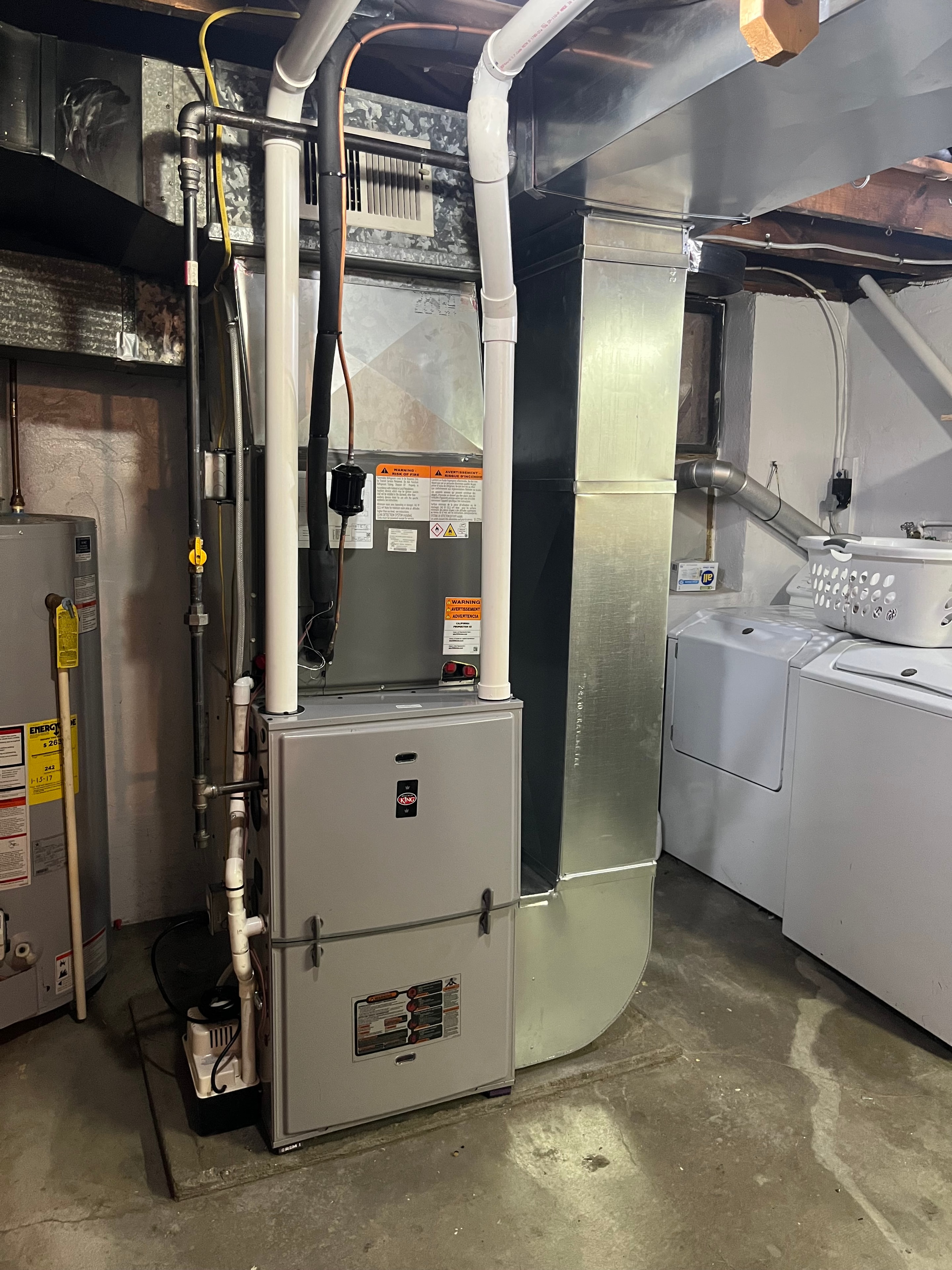
A higher furnace efficiency rating can reduce fuel use, but venting, drainage, installation scope, and comfort features also affect the decision. Here is how to compare your options.
A high-efficiency gas furnace uses less fuel to produce the same amount of heat than an 80% furnace. Whether that makes it the better purchase for your home depends on the complete installed price, venting and drainage requirements, heating demand, and the features included in each proposal.
For Pittsburgh-area homeowners, this decision deserves a look at the house as well as the equipment. An existing chimney, a nearby gas water heater, and the route available for new vent piping can all affect the project.
What does an 80% or 96% furnace rating mean?
AFUE stands for Annual Fuel Utilization Efficiency. It measures how efficiently a furnace converts fuel energy into useful heat over a standardized heating season.
An 80% AFUE furnace converts approximately 80 units of every 100 units of fuel energy into useful heat. A 96% AFUE furnace converts approximately 96 units.
High-efficiency gas furnaces generally use condensing technology to recover additional heat from combustion gases. That process produces liquid condensate, which must drain properly.
AFUE is useful for comparing fuel efficiency. It does not tell you how evenly the house will heat, how quiet the system will be, or what your entire utility bill will total.
Why venting can change the installation price
An existing furnace's venting cannot automatically be reused with its replacement.
An 80% furnace typically sends hotter combustion gases through an approved metal vent or chimney arrangement. The contractor still needs to evaluate the vent's condition, size, and suitability for the proposed equipment.
A condensing furnace removes more heat from those gases. Its cooler exhaust and condensate require a different venting approach, often using approved nonmetallic piping. The appropriate materials, pipe size, route, and termination depend on the furnace's installation instructions and applicable requirements. A direct-vent configuration also brings combustion air from outdoors.
For a Pittsburgh-area home, practical questions include: Can the vent reach an appropriate exterior location? Will the route pass through finished rooms or difficult-to-access spaces? Can the termination meet requirements near windows, doors, walkways, and expected snow accumulation? What work is needed where piping passes through the building? These details belong in the assessment and written proposal.
Check what happens to a shared water-heater vent
If the old furnace shares a chimney or vent with a gas water heater, removing the furnace can change how that remaining appliance vents. The contractor should evaluate whether the remaining vent system is properly sized and operates safely. A liner or other modification may be necessary.
This does not automatically mean the water heater needs replacement. It means the furnace project must account for the equipment that stays.
Why condensate drainage matters
A condensing furnace produces water during normal heating operation. That water needs a properly designed drainage path. Depending on the installation, the project may require a condensate pump, additional piping, or treatment required by the equipment instructions or local requirements. Components exposed to freezing conditions need appropriate protection.
Ask where the condensate will go, how the drainage system will be maintained, and whether the necessary work is included in the quote. An air conditioner may already have a drain nearby, but that alone does not establish that the furnace's drainage requirements are satisfied.
How much fuel could a higher-efficiency furnace save?
Compare the fuel needed to deliver the same amount of useful heat. Simply subtracting the AFUE ratings does not give the percentage reduction in fuel consumption. For example, moving from 80% to 96% AFUE represents approximately 16.7% less furnace fuel use under equal heating-demand assumptions.
The calculation is: new fuel use = existing fuel use × existing efficiency ÷ new efficiency.
Compare the additional installed cost with the expected benefit
A higher AFUE rating does not establish how much more a project should cost. One proposal may include a straightforward vent route. Another may require a longer route, a condensate pump, or work on the remaining water-heater vent. Equipment features and written coverage may differ, too.
Ask for the complete installed price of each suitable option, with the differences identified. A basic fuel-only payback estimate divides the additional installed cost by the estimated annual fuel savings. That calculation is a starting point: financing costs, maintenance, future fuel prices, and how long you expect to use the system also affect the decision.
Efficiency and comfort features are separate decisions
A higher AFUE rating does not automatically mean two-stage heating, a variable-speed blower, or quieter operation. Some 80% furnaces offer two-stage heating. Some high-efficiency furnaces use single-stage heating. Compare the exact models rather than assuming the efficiency label describes every feature.
Ask about: heating stages and how the furnace adjusts its heat output; blower operation and how airflow is controlled; thermostat compatibility; equipment sizing and what assessment supports the recommended heating capacity; and whether the existing ductwork can support the required airflow.
What should a written furnace proposal explain?
Before choosing between efficiency levels, request clear answers to these questions: What exact model, AFUE rating, and heating capacity are proposed? What supports the recommended equipment size? What venting and combustion-air work is included? Does removing the old furnace affect another appliance's vent? What condensate drainage work is needed? Are duct connections, controls, applicable permits, and equipment removal included? What startup checks will be completed and documented? What manufacturer and labor coverage applies? What assumptions support any projected operating-cost savings?
Frequently asked questions
Is a high-efficiency furnace always the better choice? It offers greater rated fuel efficiency. The purchase decision also depends on the installed price, heating use, installation requirements, comfort features, and ownership plans. Compare suitable options for the actual home.
Can a high-efficiency furnace use my existing chimney? Do not assume it can reuse the existing chimney connection. A condensing furnace requires an approved venting system. The contractor should explain the proposed route and evaluate any appliances that will remain connected to the chimney.
Will a 96% furnace lower my entire gas bill by 16.7%? No. The 16.7% figure describes the modeled reduction in furnace fuel use when comparing 80% and 96% efficiency at equal useful heat output. Fixed utility charges, blower electricity, water heater gas use, and other factors are not included. Actual results depend on fuel prices, weather, thermostat settings, equipment condition, and installation.
What you are comparing
| Factor | 80% gas furnace | High-efficiency condensing furnace |
|---|---|---|
| Fuel efficiency | About 80% AFUE | Commonly 90% AFUE or higher; compare the exact model |
| Exhaust venting | Typically an approved metal vent or suitable chimney system | A vent system approved for the specific condensing furnace — often nonmetallic piping |
| Condensate drainage | Generally does not require a drain for the heating process itself | Requires condensate drainage; may need a pump, piping, or treatment |
| Comfort features | Depend on heating stages, blower, controls, and installation | Also depend on heating stages, blower, controls, and installation |
| Project cost | Depends on equipment and required installation work | May include additional venting, drainage, and related work |
Hypothetical savings example
The following is a simplified illustration only — not a Pittsburgh utility-rate estimate, customer bill, or Heirloom quote. Actual results depend on fuel prices, weather, thermostat settings, equipment condition, and installation.
Assumptions: an 80% furnace uses 800 therms of natural gas annually for space heating; gas charges that vary with consumption total $1.50 per therm; the replacement operates at 96% efficiency; the home needs the same amount of useful heat, with unchanged duct losses and operating conditions.
| Item | Value |
|---|---|
| 80% furnace annual fuel use | 800 therms |
| Gas charge (variable portion) | $1.50 / therm |
| 80% furnace annual heating-fuel cost | $1,200 |
| 96% furnace annual fuel use | ~667 therms |
| 96% furnace annual heating-fuel cost | ~$1,000 |
| Modeled annual fuel savings | ~$200 |
The calculation: new fuel use = existing fuel use × existing efficiency ÷ new efficiency. This example excludes fixed utility charges, blower electricity, maintenance, and gas used by water heaters or other appliances.
For a useful household estimate, ask the contractor to explain how they separated furnace heating use from other gas consumption.
Our guide to why two HVAC quotes can be thousands of dollars apart explains how differences in scope affect the comparison.
If replacement itself is still an open question, start with how to weigh furnace repair or replacement.
Our HVAC replacement guide for Pittsburgh homeowners covers the broader planning process.
Explore our heating and furnace repair services or HVAC installation and replacement services.
Find HVAC Service in Your Community
Explore local heating, cooling, repair, replacement, and maintenance information for the communities we serve.
Heirloom Mechanical
Pittsburgh-area HVAC experts serving Allegheny, Westmoreland, Fayette & Washington counties
Need HVAC service in Pittsburgh or Southwestern PA?
Available 24/7 for emergency service. Honest estimates, certified technicians, PA HIC No. PA196206.